
Building Your 2027 Development Calendar in Q4: A Practical Sequence for Nonprofits

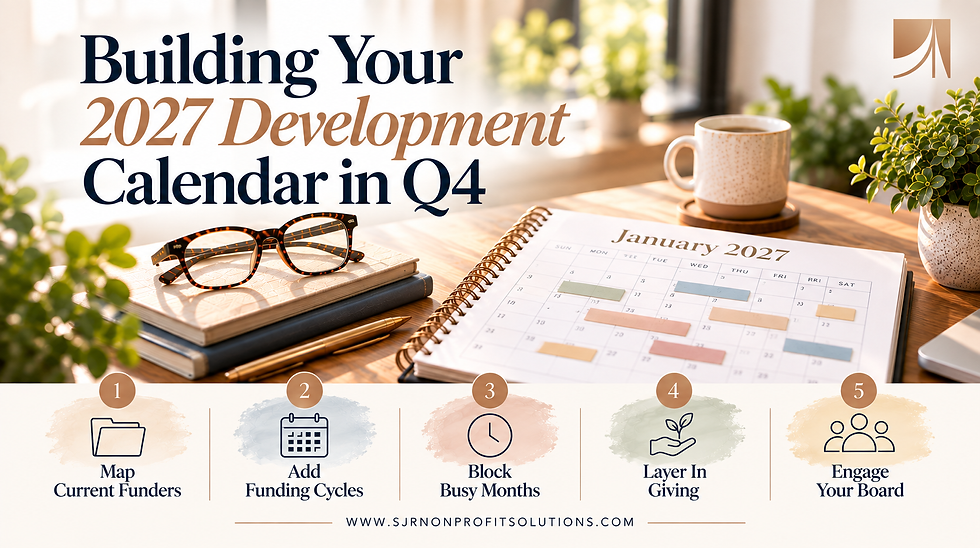
Why Q4 is the planning window
A development calendar built in January is usually a list of deadlines already in motion. One built in Q4 is a plan.
The difference is timing. By January, the first applications of the year are already due, renewal conversations have started, and the calendar fills in around whatever arrives first. Planning at that point means reacting with better organization.
The last quarter of the year offers something January can't: room to see the whole year before it starts.
Several things line up in Q4 that make it the right time to build your nonprofit development calendar for 2027:
Budgets are in draft. Program and operating budgets for next year are taking shape, so funding targets can be set against real numbers instead of estimates.
Renewals are known. Most organizations can see which current grants end, renew or require reports in the coming year.
The board is already looking ahead. Fall and December meetings tend to turn toward next year, which makes it a natural time to ask for input and commitment.
The sequence below is designed to be completed before your December board meeting. It doesn't require new software or a large team. It does require a few protected hours and an honest look at your organization's capacity.
One note before you start: a development calendar is not just a grant calendar. Grants are often the most deadline-driven part of the work, but the strongest calendars hold individual giving, events and stewardship in the same view, so that no single month carries more than your team can deliver.
Step 1: Map every current funder
Start with the relationships you already have. For each active funder, record:
Final and interim report due dates
The renewal window, or the date a new request would be due
The date of your last meaningful contact, and who made it
One line on what that funder cares about most right now
This is usually the most valuable hour in the whole process. Renewals and reports are the most predictable part of next year's funding, and they're the easiest to lose track of when attention shifts to new opportunities.
If the last contact date for a funder is more than six months ago, note it. That's a relationship to tend before the next request, not after.
Step 2: Layer in known recurring cycles
Next, add the opportunities that come around on a predictable schedule, even if you haven't applied before:
State funding cycles your organization is eligible for, along with any pre-application or registration steps
Federal forecasts for programs in your field. Forecasts posted on Grants.gov often signal timing months before a notice of funding opportunity is released.
Foundation cycles with published deadlines or letter-of-inquiry windows that align with your mission
Mark these as tentative. Dates shift, and priorities change. The goal at this stage is to see roughly when the year's major opportunities are likely to land, not to commit to every one.
Federal and state timelines in particular may move from year to year. Treat a forecast as a planning signal, and revisit it at each quarterly checkpoint.
Step 3: Mark your capacity blackout months
This is the step most calendars skip, and the one that makes the rest of the plan hold.
Every organization has months that are already spoken for, even when no grant deadline sits on them:
Audit and year-end financial close
The year-end appeal season
Peak program months, such as summer programming or a major annual event
Predictable staff leave or transitions
Block these out before adding anything new. When those months aren't marked, grant deadlines land on top of them, and the work gets rushed or dropped.
If a high-priority opportunity falls inside a blackout month, that's useful information. It may mean starting the application earlier, sharing the work differently, or deciding that this cycle isn't the right one.
Step 4: Add individual giving, events and stewardship
With grants and capacity mapped, bring in the rest of the development work:
Appeal mailings and online giving campaigns
Events and their planning lead time
Donor stewardship touchpoints: thank-you calls, impact updates and no-ask check-ins
Newsletters and other regular communications
Seeing everything in one view shows where months are overloaded, and where there's room to strengthen relationships without a deadline attached.
A lean team can't do everything in every month. The calendar's job is to make the tradeoffs visible early, while there's still time to adjust.
Step 5: Set quarterly checkpoints
A calendar that gets built in October and opened again the following October is an archive, not a plan.
Schedule four short checkpoints, one at the start of each quarter, to review:
What was submitted, awarded, declined or deferred
Which forecasted opportunities have firmed up or fallen away
Whether capacity assumptions still hold
What needs to move to the next quarter
Put these on the calendar now, with an owner for each one. Thirty to sixty minutes is usually enough.
Step 6: Bring the draft to the board in December
A development plan the board sees in December is a very different document from one it sees for the first time in February.
In December, board members can shape priorities, weigh in on capacity and commit to specific roles, such as making introductions, supporting the appeal or hosting an event. By February, the plan is already underway, and board input becomes feedback instead of ownership.
Bring a working draft, not a finished product. Ask the board for three things:
Input on priorities: which opportunities matter most to the mission
A realistic read on capacity, including where board members can help carry the work
Specific commitments, with names and months attached
To reach the December meeting with a draft in hand, most organizations need to start the work in October or early November.
A plan built around your real capacity
The purpose of this sequence isn't to fill every month. It's to build a calendar around your team's actual capacity, not an optimistic version of it.
Organizations that go into January with renewals mapped, capacity marked and the board engaged aren't starting the year from zero. They're starting from a plan they can adjust, rather than one they have to invent under deadline pressure.
If you complete only the first three steps this fall, your organization will still go into 2027 with a clearer view than most.
Support for building your 2027 plan
For organizations that want a partner in this work, SJR Nonprofit Solutions offers Q4 Grant Launch support, focused on putting your 2027 grant calendar and funding strategy in place before January.
To see whether it's the right fit for your organization, book a short discovery call: calendly.com/sroberts-sjrnonprofitsolutions/30min
Looking to plan beyond grants? Stay tuned for the SJR Nonprofit Fundraising Toolkit, a DIY resource launching later this month.
Sarah J. Roberts, GPC, is the founder and principal consultant of SJR Nonprofit Solutions, a consultancy based in New Hampshire's Lakes Region that helps nonprofits build sustainable funding strategies.


